eXTReMe Tracker

27 February 2009

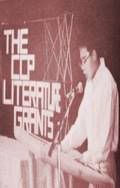
59th carlos palanca memorial awards for literature now accepting entries

Introduces `Poetry for Children' As New Category

On its 59th year, the Carlos Palanca Memorial Awards for Literature (Palanca Awards), the country's most prestigious and longest-running literary contest, officially opens on March 1, 2009.

This year, the Palanca Awards announces the introduction of two new categories – Poetry Written for Children in the English Division and Tulang Isinulat Para sa mga Bata in the Filipino division.

In these new categories, envisioned to encourage the development of a body of poetry for young children, an entry must consist of a collection of at least 10 but not more than 15 poems. It may deal with any subject and must be comprehensible within the grade-school reading level of children ages 6-12, but accessible in its oral form by younger children.

The complete regular categories under which participants can submit their entries are: English Division – Short Story, Short Story for Children, Essay, Poetry, Poetry Written for Children, One-act Play, Full-length Play; Filipino Division – Maikling Kuwento, Maikling Kuwentong Pambata, Sanaysay, Tula, Tulang Isinulat Para sa mga Bata, Dulang May Isang Yugto, Dulang Ganap ang Haba, and Dulang Pampelikula; Regional Languages Division – Short Story-Cebuano, Short Story-Hiligaynon and Short Story-Iluko. Each contestant may submit only one entry per category.

Meanwhile, in the Kabataan Division, Palanca Awards' special division for young writers below 18 years old, the Kabataan Essay theme in the English category is "How can the Filipino youth help build a globally competitive nation?" and in the Filipino category "Paano makatutulong ang kabataang Filipino sa pagtataguyod ng isang maunlad na bansa na maihahanay sa mga nangungunang bayan sa buong mundo?"

The literary contest is open to all Filipino (or former Filipino) citizens, except current officers and employees of its organizing body, the Carlos Palanca Foundation, Inc. Contest rules and official entry forms are available at Palanca Awards' official website, www.palancaawards.com.ph.

Entries with complete requirements may be submitted to the Foundation's office at the 6th Floor, One World Square Bldg., 10 Upper McKinley Road, McKinley Hill Town Center, Fort Bonifacio, Taguig City or may also be entered online through the Palanca Awards website or sent through email at palancaawards@yahoo.com.

Deadline of submission of entries for this year's awards is midnight of April 30, 2009. Winners will be announced on September 1, 2009.

For further information, you may call telephone number 856-0808.

Labels: , ,

09 November 2007

butch dalisay in international herald tribune

International Herald Tribune

Belatedly, Asia's literary scene comes of age

HONG KONG: By Donald Greenlees

When Xu Xi's first novel was printed in 1994, she thought she had finally broken down the barricades of the publishing houses. She felt she had entered an inner circle where, even if the writing was still hard work, the rewards of being printed and read would flow a little more easily.

She soon discovered that being published in English by a small printing house in her hometown, Hong Kong, did not ensure the interest of the handful of companies based in the United States and Britain that dominate global English-language publishing.

After that first novel, "Chinese Walls," set in the 1960s in a Hong Kong that was poor and crowded with raucous bars filled with GIs on leave from the Vietnam War, she went on to write five more. She even moved to New York in the hope that, somehow, proximity to international publishers might help open their doors.

"Publishers in New York and London were encouraging," she said. "But they didn't basically know what to do with a Hong Kong writer."

In October, that started to change. Xu's latest novel, "Habit of a Foreign Sky," made it onto the short list for Asia's first literary prize of real international standing.

Her gritty tales of the lives of Hong Kongers, free of the stereotypes in many of the Western accounts of the former British colony, had long been hailed by scholars, dissected in creative writing classes and popular with Hong Kong and Chinese-American readers.

But when she and four other authors were named as finalists for the Man Asian Literary Prize, international publishers suddenly took notice. The prize, which recognizes Asian novels unpublished in English, is to be awarded for the first time Saturday.

"Since I made the short list three publishers have called my agent - one from New York, one from London and one from Australia," she said. But her reaction was: "This is nice; isn't it about time?"

Many writers of Asian fiction, who have struggled for years to be acknowledged outside small audiences in their own countries, would endorse that sentiment.

But there are signs the Asian literary industry is starting to come of age, increasing the opportunities for many more Asian writers to gain international recognition.

International publishers and literary agents say they are seeking many more works in Asia to bring to English-language audiences. They are also looking for new voices and genres that go beyond what publishers call "scar" or "misery" literature - about life in poverty under repressive regimes - and capture the rapid social and economic transformation of the new Asia.

At the same time, they say Asia is building the infrastructure for a developed literary industry. They say it can be seen in the growth of international publishers opening regional offices to scout for talent and sell books in fast-growing English- and local-language markets; the emergence and greater importance of Asian literary festivals; and the numbers of Asian works being translated into Western languages.

"Until recently, you would have been hard-pressed to identify what I call a literary industry in Asia," said Peter Gordon, the editor of The Asian Review of Books and a publisher based in Hong Kong.

"But there are indications the industry has developed and now exists. There comes a moment where a number of distinct points gel into what you call an industry."

The consequences will be an increasing volume of works of fiction coming out of Asia in the years ahead amid an expanding market within Asia for fiction in both English and local languages.

Like the rest of the Asian story, China and India dominate the business calculus.

The British publisher Penguin, which opened a China office in late 2005, has recorded sales growth of 200 percent a year, according to Jo Lusby, the general manager of Penguin China, based in Beijing.

"It's a market we believe is underserved," Lusby said. "It's a very exciting market for us."

Penguin has been selling English-language titles in China and translations of popular children's stories. But the majority of consumers of books in English are no longer expatriates, she said. They are now middle-class Chinese.

At the end of this year, Penguin will also introduce its first Chinese translations of classic English literature under the Penguin logo in a deal with a state-owned publisher. It plans to bring out 30 new titles in this series a year.

Gordon, who runs Chameleon, a small publisher, and an online book seller in Hong Kong, said the consumption of fiction was matching the "exponential growth" of Asia's economies.

"When people have growing incomes, they start to buy CDs and they start to buy books," he said. "Increasing demand means people write more books and you have a virtuous cycle."

A prime motivation for international publishers to set up offices in the region is to find new authors. Late last year, HarperCollins signed a collaboration agreement with the People's Literature Publishing House and announced its first project: three Chinese novels to be translated into English.

In April, PanMacmillan started Picador Asia with the aim of acquiring three to four titles a year related to East Asia.

The decision to begin recruiting in China could pay off handsomely for Penguin with the signing of translation rights to a book by a 61-year-old retired Chinese academic who uses the pen name Jiang Rong. His "Wolf Totem" led China's best-seller list in 2004, selling two million copies in its legitimate edition and an estimated four million pirated copies.

Jiang, who based the book on his own experiences in Inner Mongolia in the 1960s, also made it to the short list for the Man Asian Literary Prize. The book, which Lusby described as a sharp departure from the bitter memoirs of early Communist rule that have come out of China in recent years, will be released in English in March.

Marysia Juszczakiewicz, a literary agent with Creative Work in Hong Kong, said the growing presence of international publishers in Asia was resulting in the discovery and translation of authors who might never have been noticed outside their own countries.

Until recently, Jiang "would probably not have been discovered because there are so few people looking," she said. "Before, publishers would not have been looking actively at best-seller lists in China and thinking whether that would have worked outside."

Juszczakiewicz, who represents Xu, said one effect is that foreign audiences are going to be exposed to a much wider range of authors and styles of fiction than they have seen in the past from much of Asia. She cited one of her own authors, Feng Tang.

"He is the Nick Hornby of China," she said. "He is very funny."

But China is fashionable now and, even so, only a few writers are likely to benefit.

Like writers elsewhere, most aspiring Asian novelists can look forward to the demoralizing combination of anonymity and financial hardship, said Jose Dalisay, a Filipino author.

Dalisay is also in the running for the Man Asian Literary Prize and did get calls from international publishers after his darkly comic book, "Soledad's Sister," made the short list. But he does not expect to be able to turn writing into a full-time living any time soon.

"I am always scrambling for jobs," he said. He juggles low-paid work teaching English at a university with part-time journalism and other writing assignments.

"The acclaim is there," he said. "The Philippines is a society that, strangely enough, values its writers and artists but hardly pays them anything."

Labels: , , ,

Link

12 October 2007

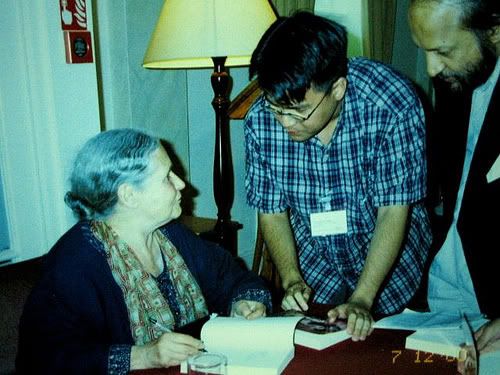
with doris lessing, 2007 nobel prize winner for literature


Photo Sharing and Video Hosting at Photobucket

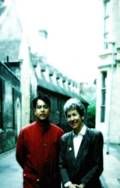
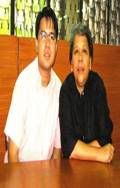
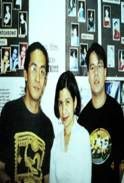
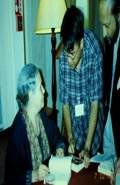
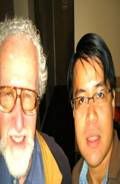
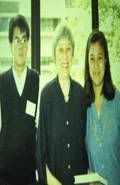
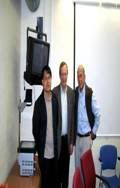
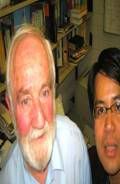
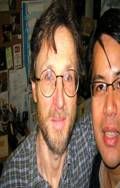
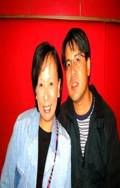
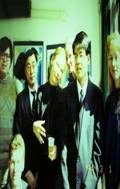
with 2007 nobel prize laureate for literature doris lessing and malaysian fictionist shan (m. shanmughalingam) at downing college, university of cambridge (12 july 2000)

***

Britain's Doris Lessing wins 2007 Nobel Literature Prize

Source: International Herald Tribune

NEW YORK: Doris Lessing, Nobel laureate. This year's winner of the literature prize should inspire a fresh look at the long, prolific career of the author of "The Golden Notebook" and dozens of other works, and a fresh debate about the taste of Nobel judges.

The 87-year-old Lessing, whose novels, short stories, memoirs and plays have reflected her own unexpected journeys across time, space and ideology, was praised Thursday by the Swedish Academy for her "skepticism, fire and visionary power."

"I've won all the prizes in Europe, every bloody one, so I'm delighted to win them all," said Lessing, alighting from a taxi outside her brick row house in North London as reporters gave her the news. Her previous honors include the James Tait Black Memorial Book Prize and the W.H. Smith Literary Award.

"It's a royal flush," she said.

For at least one generation of women, "The Golden Notebook," Lessing's 1962 novel about a writer's personal and political reckoning, was a moment of self-discovery comparable to "Catch-22" for anti-war protesters or "The Catcher in the Rye" for teenagers.

But the Swedish academy's announcement was stunning even by the standards of Nobel literature judges, who have been known for such surprises as Austria's Elfriede Jelinek and Italy's Dario Fo, picks challenged for valuing political dissent over artistic merit.

Lessing, almost two weeks short of her 88th birthday, is the oldest choice ever for a prize that usually goes to authors in their 50s and 60s. Although she continues to publish at least every other year, she has received little attention for her recent work and has been criticized as didactic and impenetrable.

"This is pure political correctness," American literary critic Harold Bloom, commenting on Lessing's Nobel, told The Associated Press. "Although Ms. Lessing at the beginning of her writing career had a few admirable qualities, I find her work for the past 15 years quite unreadable ... fourth-rate science fiction."

Lessing, ironically, is herself a critic of political correctness who broke with the British Communist Party in the 1950s, has often presented women (including herself) as vain and territorial and has insisted that "The Golden Notebook" is not a "trumpet for Women's Liberation," as she wrote in the introduction for a 1993 reissue.

"I think a lot of romanticizing has gone on with the women's movement," she told the AP in a 2006 interview. "Whatever type of behavior women are coming up with, it's claimed as a victory for feminism — doesn't matter how bad it is. We don't seem go in very much for self-criticism."

The former Doris May Tayler has never liked to be told what to do, or how to think. In her memoir, "Under My Skin," published in 1994, she remembered herself as a contrarian child with a mantra of three stubborn words: "I will not."

She didn't need teachers; only her eyes and mind. As a girl, she read "The Secret Garden," biblical tales, Rudyard Kipling, history books about Napoleon, the Crusades, and Benjamin Franklin and Charles Dickens, whom she chose against the advice of the nuns in her convent. By age 10, she had written a one-act play featuring Shakespearean monarchs.

"I didn't go to school much, so I taught myself what I knew from reading," Lessing, who dropped out as a teenager, said in 2006.

Born in Persia (now Iran) and witness to the collapse of governments (Rhodesia), empires (the British), ideologies (Communism, Nazism) and two of her own marriages, Lessing has long given up on seeing the world as capable of being mastered, whether for good or for evil.

"She is a realist," says fellow author Shirley Hazzard, whose "The Great Fire" won the National Book Award for fiction in 2003. "Her intention is not to amuse. She's a serious writer who deals with thing she feels very, very strongly about."

The variety of her work seems infinite — from colonial Africa in "The Grass Is Singing" to dystopian Britain in "Memoirs of a Survivor" to the new Ice Age in "Mara and Dann." She has been influenced by Sufism and Communism and collaborated with Philip Glass on a science fiction opera.

But her books are unified by parallel themes: Nothing lasts; nothing really changes. Whether a marriage or an army of millions, she can imagine its birth and its death. She sees herself as a particular kind of person — living in a certain time and place — who could have easily turned out differently.

"When you look at my life, you can go back to the late 1930s," she said in 2006. "What I saw was, first of all, Hitler, he was going to live forever. Mussolini was in for 10,000 years. You had the Soviet Union, which was, by definition, going to last forever. There was the British empire — nobody imagined it could come to an end. So why should one believe in any kind of permanence?"

***

Doris Lessing
Lessing was born in Persia and grew up on a farm in southern Africa
Doris Lessing, who has won the 2007 Nobel Prize for Literature has been one of Britain's most prominent writers for more than 50 years.

Her novels, most notably The Grass is Singing and The Golden Notebook, weave political and sexual themes into a complex narrative thread.

Lessing's themes are big ones: racism, communism, terrorism and environmental destruction.

Her output ranges from romances through to science fiction and take in the most intimate internal dialogues and sweeping historical set-pieces.

Doris May Taylor is a child of the British Empire. Born in Persia - now Iran - in 1919, she was brought up in Southern Rhodesia - now Zimbabwe - where her father owned a farm.

Her African childhood, amid the vastness of the bush and her time at convent schools, brought her a wealth of inspiration.

In 1949 after two failed marriages, the second to a hard-line communist, Gottfried Lessing, she left Africa, and most of her family, and moved to London to try her hand at writing.

Multi-layered tales

Lessing's first novel, The Grass is Singing, published the following year, was an instant bestseller.

The story of the wife of a white farmer and her affair with an African servant, the book broke new ground, both in terms of its outlining of an interracial relationship and in the sheer detail Lessing gave to her characters' internal lives.

Perhaps Lessing's most controversial novel was The Golden Notebook, published in 1962.

A multi-layered story about the different areas of one woman's personality, her passions and hatreds, it is by far the most complex, and longest, work Lessing has ever produced.

Doris Lessing
Lessing has written more than 30 novels
She has also produced startling works, such as the semi-autobiographical Children of Violence series and Briefing for a Descent into Hell (1971), a frightening and surreal examination of mental illness.

By the late 1970s, Lessing left the African-themed novel behind and moved into science fiction.

In the Canopus in Argos series, she outlines a dystopic vision of the future, with natural catastrophes and tyranny becoming the norm.

The critic, Paul Schlueter, noted that Lessing's "high seriousness in describing Earth's own decline and ultimate demise is as profoundly apocalyptic as ever".

More recently, Lessing has produced novels like The Good Terrorist (1985), a satire on romantic politics, and The Fifth Child (1988), about the havoc wreaked on a family by an antisocial and violent child.

Her latest work, The Cleft, is a sci-fi novel which imagines what happens to a mythical all-female world when men are introduced.

Speaking at the Hay literary festival in June, Lessing said the book had been partly inspired by her own experience of giving birth at 19 and the woman in the next bed, already a mother of two girls, harshly rejecting the son she had just had.

The writer also addressed her critics - saying she had been surprised by the "horrible" early reviews of The Golden Notebook.

"There's something abrasive in me because I have often made people very cross," she mused.

But she said as a writer it was important not to care what other people think and that the profession must honour that.

"We are free... I can say what I think. We are lucky, privileged, so why not make use of it?"


Labels: , , , ,