eXTReMe Tracker

09 November 2010

From Lito D. Zulueta, Philippine Daily Inquirer: Media, letters mourn death of Ophelia Alcantara-Dimalanta

THE DEATH of Ophelia Alcantara-Dimalanta, poetess extraordinaire, writer-in-residence and former dean of the Faculty of Arts and Letters of the University of Santo Tomas, and supreme doyenne of at least two generations of poets, writers and literature educators in the country, has touched off a wave of grief in the media and literary world.

Dimalanta died in her Navotas home Thursday night of an apparent heart attack. She was in her late 70s.

One of the first to attend her wake at Floresco Funeral Homes in Malabon was National Artist F. Sionil Jose.

Dimalanta was an award-winning poet in English whose several collections, especially “Montage” (1974), “Time Factor” (1984), “Flowing On” (1988), and “Lady Polyester” and “Other Poems Past and Present” (1993), have remained treasured by literature lovers for their technical craftsmanship, uncanny musicality and fine sensibility.

The first lines of “Montage,” which won the Palanca Grand Prize for poetry and Best Poem of the Year of the Iowa State University in the United States, are often quoted by poetry lovers and reveal Dimalanta’s mastery of metaphor, versification and insight: “Monday jolts and she bogs down,/ A ragbag splayed off at tangents.”

In depicting a woman with a hangover from weekend but forced to contend with the Monday rush, Dimalanta is said by critics to be portraying the Filipino woman in transition—from housewife to modern career woman, much like herself, who was raising a family while teaching and writing professionally. Feminist critics now call her a pioneer feminist, although she remained ambivalent about the claim.

Dimalanta also became noted for her erotic poetry, much to the consternation of the Dominican fathers whose UST Publishing House has published nearly all her collections. She once rewrote the famous lines of John Donne—“for chrissake, hold your tongue and let me love!” to “for chrissake, hold your tongue and let me come!”

But her most enduring verses will probably be those about love and its ineffability. One of her most famous poems is “A Kind of Burning,” about love that remains love because it is kept at a distance, unconsummated and unrealized, so that the burning seems to last forever. Its last lines are often quoted by her fans: “we have been all the hapless/ lovers in this wayward world/ in almost all kinds of ways/ except we never really meet/ but for this kind of burning.”

Dimalanta was also an award-winning critic, fictionist, essayist and textbook writer. She took up all her higher degrees at UST. In college, she was literary editor of the official student organ, The Varsitarian, where she published the first poem—in English—of a classmate and co-staffer who would become a National Artist for Literature, Bienvenido Lumbera.

After graduating with a Journalism degree from the old UST Faculty of Philosophy and Letters, she taught in the same school, which later became the Faculty of Arts and Letters.

As a teacher, Dimalanta followed a long line of well-loved literature pedagogues from UST: Paz Latorena (the teacher of F. Sionil Jose), Clemencia Colayco, Josephine Bass-Serrano, Erlinda Rustia (the favorite teacher of Lumbera),Carolina Garcia and Milagros Tanlayco.

Her students would constitute the Who’s Who of Philippine letters: Rogelio Sicat, Cirilo Bautista, Francisco Tatad, Cristina Pantoja-Hidalgo, Norma Miraflor, Rita Gaddi, Arnold Molina Azurin, Bernardo Bernardo, Antonio Lopez, Nestor Cuartero, Merlinda Bobis, Vim Nadera, Mike Coroza, Rebecca Anoñuevo, Neil Garcia, Wendell Capili, Angelo Suarez and several others.

A prayer

In the Inquirer, her former students include Rina Jimenez David, Ruben Alabastro, Miguel Suarez, Chito de la Vega, Voltaire Contreras, Christian Esguerra and many others.

In the the media in general, her former students include Glenda Gloria, operations chief of ANC; Fr. Nick Lalog of Radio Veritas; Isabel de Leon of Manila Bulletin; and Rodolfo Lana of GMA.

She was also mentor to several activists, such as Ronald Llamas of Akbayan.

Cuartero, editor of the Manila Bulletin and Tempo and a journalism professor at UST, said Dimalanta was an excellent teacher.

“She pushed us to do our best,” he said. “The way she writes alone inspires. I feel so sad. She’s like a mother you come home to when you go to UST. But now our mother is gone.”

Coroza, a professor at Ateneo de Manila University, dedicated a prayer to her:

Ma’am Ophie, mahal na mahal kita na parang tunay kong ina. Paumanhin at ‘di ko natupad ang pangakong pagdalaw sa iyo nitong Hunyo at Hulyo. Mamayapa ka sa piling ng Lumikha. Mabuhay nang walang hanggan ang iyong talinghaga.

Necrological Mass for Ophelia Alcantara-Dimalanta will be tomorrow, 9:30 a.m., at the UST Santissimo Rosario Church. Main celebrant is UST Rector Magnificus Fr. Rolando V. de la Rosa, OP. On the eve of the burial and necrological Mass, a writers’ vigil is being held at UST.

Ophelia Alcantara Dimalanta

Labels: ,

Link

07 November 2010

ABS-CBN News: UST poet Ophelia Dimalanta dies, 76

MANILA, Philippines - Ophelia Alcantara-Dimalanta, one of the country's premiere women poets, died of a stroke on Thursday. She was 76.

Born June 16, 1934, Dimalanta finished her undergraduate and post-graduate studies in literature in the University of Santo Tomas. She started teaching in 1953 and became dean of the UST Faculty Arts and Letters in the 1990’s.

Dimalanta published three books : Anthology of Philippine Contemporary Literature, Readings from Contemporary English and American Literature, and The Philippine Poetic; and a collection of poems, Montage, which won the Iowa State University best poetry award(1969), and first prize in the Palanca Memorial awards for literature(1974).

She received numerous honors for her work, including the prestigious South East Asian or SEA Write Award in 1999, the Catholic Authors Award in 1995, and The Outstanding Thomasian Alumni Award in 2002. She was named UST's writer-in-residence last year. With a report from Kalaine Nikka Kay C. Grafil, UST Varsitarian

Labels: ,

Link

24 July 2009

gemino abad receives premio feronia in italy

Link

17 May 2009

Pinoy poet to receive Italy's top prize

Pinoy poet to receive Italy's top prize
Philippine Star
Updated May 17, 2009 12:00 AM

Photo is loading...
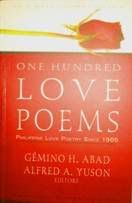
Gemino Abad

MANILA, Philippines – Poet and critic Gémino Abad has been named this year’s recipient of Italy’s most coveted literary prize, the Prize Premio Feronia – Citta di Fiano 2009 under the foreign author category. The prize will be conferred on July 11 during the Nomination Ceremony at the historic Castle of Fiano Romano outside Rome.

In a letter from President of the Committee Filippo Bettini, Abad has been requested to personally attend the ceremony to receive his prize, which includes a cash award of 3,600 euros. Abad has also been invited to attend the Italian Festival Mediterranea in Rome.

Abad holds the highest rank of University Professor at the University of the Philippines (UP), and teaches creative writing at the College of Arts and Letters as Professor Emeritus. He also sits on the Board of Advisors of the UP Institute of Creative Writing.

Originally from Cebu, Abad earned his B.A. in English from the University of the Philippines in 1964 and his Ph.D. in English literature from the University of Chicago in 1970. He served UP in various capacities, as secretary of the university, secretary of the Board of Regents, vice president for academic affairs, while teaching English, comparative literature and creative writing. Abad co-founded the Philippine Literary Arts Council (PLAC), which published Caracoa, a poetry journal in English.

Among his many books of poetry and critical essays are Fugitive Emphasis (1973), his first book of poetry; In Another Light (poems and critical essays, 1976); A Formal Approach to Lyric Poetry (critical theory, 1978); The Space Between (poems and critical essays, 1985); Poems and Parables (1988); Index to Filipino Poetry in English, 1905-1950 (with Edna Zapanta Manlapaz, 1988) and State of Play (letter-essays and parables, 1990). He edited landmark anthologies of Filipino poetry in English, among them Man of Earth (1989), A Native Clearing (1993) and A Habit of Shores: Filipino Poetry and Verse from English, ’60s to the ’90s (1999).

The work for he has been cited is In Ordinary Time: Poems, Parables, Poetics (2004), his own selection of his poems and parables from 1973 to 2003. Ten each of these are arranged under six themes which suggest, generally, a possible terrain of signification: Things (“each thing’s special signature”), Words (“not meaning but meaningfulness”), Self (“the imagination, the self’s primary activity, creates our humanity”), Love (“the self’s deepest moral sense”).

Country (“what one’s imagination owes its allegiance to”), and God (“every person’s imagination’s Word”).

“A poetics of the word” runs through a number of poems and parables, and ends with the poet’s essay, “What for Me a Poem Is,” an essential poetics of finding one’s own path through language and making one’s own clearing there.

The Premio Feronia was established 16 years ago by the Associazione Culturale Allegorein and gives awards in four categories: poetry, narrative, criticism and a special award to a foreign author.

Previous winners of the prize include Gunter Grass, John Coetzee, Leroi Jones, Gao Xingjian, Kunwar Narain, Ismail Kadare and Yvonne Vera.

Labels: ,

Link

16 March 2009

what places inspired your literary pieces? by raychel ria c. agramon and jenny lynne g. aguilar

Like us this sun’s regress
Sliding slowly into the
River’s rim does not have
A history. We begin
The day newly born
And shriven, and end it
Wisened with age and life
Lived blood-red full

Literary goddess Ophelia A. Dimalanta, while on board M.S. Egilika, praised the longest river in the world—Nile—in her poem “Beginnings,” which is featured in her book The Ophelia Dimalanta Reader Volume 1 (UST Publishing House, 2004).

***

I have waited for the years to melt down
Your overgrown nettles, sweet dew, magic
Flowers stretching to a hundred leagues
On paddies and green mountains.

It was during Jose Wendell Capili’s stay as a Korea Foundation fellow at Seoul National University and Yonsei University in 1995 when he was to write the poem, “Resentment,” inspired by South Korea’s Secret Garden. Built in 1405, the Secret Garden is actually the rear garden of Changdeokgung Palace. Members of Korean royalty usually studied, performed martial arts, and worshipped their deities in the garden.

***

Walang pagsidlan ang walang kahulilip kong tuwa
Kaya nang biglang umulan, ako ay napaluha.
Kinagisnan kong pagtawa ay hindi ko magawa
Dahil baka bahaghari sa akin maghinala.

The towns of Aurora, Infanta, and Nakar in Quezon were devastated when typhoon Winnie ravaged hundreds of homes and farms, rendering thousands homeless, injured, orphaned—and dead. The towns, which ended under mud after a landslide in December 2004, became Quezon-born poet Victor Emmanuel Carmelo Nadera Jr.’s inspiration in his poem “Panahon.”

***

The Wei Ming is a teacher of the soul
Restless in perpetual perturbulence.
Even the Buddha would have envied her.

In his stay in Beijing, China in 1993, UST Graduate School professor Florentino Hornedo crooned over the Wei Ming lake in his poem, “Meditation on the Wei Ming.” The largest manmade lake inside the Peking University, Wei Ming literally means “No Name Lake.”

***

Ages later, the Beguines
are gone, even as their haven bravely stands,
cradling the same bright Presence. Meantime,
this city now teems with its myriad flesh,
pinks and yellows and auburns, old and new,
desiring and desired, speaking all in tongues.

Despite the infamous Red Light District being in his immediate neighborhood, poet J. Neil Garcia took comfort in writing poems about churches, specifically the Beguinage, which he frequented while in Amsterdam, Netherlands in 2004. The Beguinage, the site of a famous Eucharistic miracle in the sixteenth century, is the soul of poem “XXX,” one of 61 in “Poems from Amsterdam: A Cycle,” which was featured in his book Misterios and Other Poems (UP Press, 2005).

***

Looking back, I realized everything of it
was perfect— your eyes shy at the briefest
touching with mine the way we avoided
this love which was meant to be bigger
than us, following us towards the daylight
blessing the corridors of a beautiful world—
in a way not one of us could ever predict.

Tagged as the most saccharine poem as it is, former Varsitarian Associate Editor Carlomar Daona found the persona of his poem, “Negros Museum, June 13” as a ghostly figure trapped in the cage of his soliloquy. It is the airlessness and the uncomfortable heat in the Negros Museum that led him to frame the poem in expression of his affection and longing for someone whom at this point was already left in the pedestal of his memory.

***

Montage Literary Magazine (The Varsitarian, University of Santo Tomas), Volume 11, September 2008


Labels:

Link

27 February 2009

59th carlos palanca memorial awards for literature now accepting entries

Introduces `Poetry for Children' As New Category

On its 59th year, the Carlos Palanca Memorial Awards for Literature (Palanca Awards), the country's most prestigious and longest-running literary contest, officially opens on March 1, 2009.

This year, the Palanca Awards announces the introduction of two new categories – Poetry Written for Children in the English Division and Tulang Isinulat Para sa mga Bata in the Filipino division.

In these new categories, envisioned to encourage the development of a body of poetry for young children, an entry must consist of a collection of at least 10 but not more than 15 poems. It may deal with any subject and must be comprehensible within the grade-school reading level of children ages 6-12, but accessible in its oral form by younger children.

The complete regular categories under which participants can submit their entries are: English Division – Short Story, Short Story for Children, Essay, Poetry, Poetry Written for Children, One-act Play, Full-length Play; Filipino Division – Maikling Kuwento, Maikling Kuwentong Pambata, Sanaysay, Tula, Tulang Isinulat Para sa mga Bata, Dulang May Isang Yugto, Dulang Ganap ang Haba, and Dulang Pampelikula; Regional Languages Division – Short Story-Cebuano, Short Story-Hiligaynon and Short Story-Iluko. Each contestant may submit only one entry per category.

Meanwhile, in the Kabataan Division, Palanca Awards' special division for young writers below 18 years old, the Kabataan Essay theme in the English category is "How can the Filipino youth help build a globally competitive nation?" and in the Filipino category "Paano makatutulong ang kabataang Filipino sa pagtataguyod ng isang maunlad na bansa na maihahanay sa mga nangungunang bayan sa buong mundo?"

The literary contest is open to all Filipino (or former Filipino) citizens, except current officers and employees of its organizing body, the Carlos Palanca Foundation, Inc. Contest rules and official entry forms are available at Palanca Awards' official website, www.palancaawards.com.ph.

Entries with complete requirements may be submitted to the Foundation's office at the 6th Floor, One World Square Bldg., 10 Upper McKinley Road, McKinley Hill Town Center, Fort Bonifacio, Taguig City or may also be entered online through the Palanca Awards website or sent through email at palancaawards@yahoo.com.

Deadline of submission of entries for this year's awards is midnight of April 30, 2009. Winners will be announced on September 1, 2009.

For further information, you may call telephone number 856-0808.

Labels: , ,

23 September 2008

scenes from the 2008 carlos palanca memorial awards for literature, rigodon ballroom, manila peninsula (1 september 2008)

butch dalisay, wendell capili, jaime an lim, au yumul, jing hidalgo, tony hidalgo
mikael de lara co reads his own work
patricia evangelista reads butch guerrero
they all listened to gabe mercado
ralph galan, butch dalisay, erica valerio
with sandra palanca
with erica valerio
surigao's finest: tara sering and her prizewinning siblings
vim nadera, kael co, mike coroza
with patricia evangelista
with luis gatmaitan, m.d.
with publisher gloria rodriguez and fictionist nadine sarreal
marne kilates and jing panganiban mendoza
with ralph galan and erica valerio
with mike coroza
tara sering, mookie kaitgbak and joy cruz
with nick pichay, jun lana and ian casocot
with marra pl lanot
karina africa bolasco
nikki alfar, chuck syjuco, tara sering, dean alfar and joy cruz
with sarj lacuesta and mookie katigbak
with jun cruz reyes
with celine cristobal
with ian casocot
with tara sering and joy cruz
with glenn mas
with jerry respeto, gil mendoza and jing panganiban-mendoza
with rody vera
with eugene evasco and friend, chris martinez, frank rivera and hermie beltran
tony hidalgo, jing hidalgo, chuck syjuco and jimmy abad
with jaime an lim
charlson ong, tony hidalgo, jing hidalgo
jimmy abad, krip yuson and vince groyon
with mon and nemy bermejo

Labels: , ,

17 May 2008

in makati for the romeo forbes short story competition

canvas (1/of gallery, 2nd level shops, serendra, global city, tagig) invited me to judge this year's romeo forbes short story for children competition. judging meant going to makati all the way from u.p. diliman.

after the preliminaries, canvas executive director gigo alampay invited this year's judges (me, tin-aw art gallery owner and u.p. alumna dawn atienza and tony / lawrence olivier prizewinning singer/actress lea salonga) to have some afternoon tea at chateau 1771 in greenbelt 5.

the judges enjoyed reading the finalists anonymously. i wondered whether i had past and present students in the finals. surprisingly, we didn't have to labor over our shortlisted finalists and the eventual winner.

by unanimous decision, the winner turned out to be:
doll eyes by eline santos

the following writers made the short list:

the search for magic by raissa rivera

father damian's amazing carabao by becky bravo

ang dyip ni mang tomas ni genaro r. gojo cruz

alay sa huling babae sa bayan ng suna ni michael frianeza

the first jeepney by agay llanera

after deciding on the eventual winner, the judges begged gigo to reveal the names of the winner and the shortlisted finalists. i was thrilled to discover that i know two of the finalists. raissa rivera won her first or second palanca for futuristic fiction with me as one of the judges. frequent palanca winner becky bravo was my student in comm 1 (freshman english) and comm 2 (types of academic discourse) in u.p. diliman many years ago. i am certain these two writers will not stop writing. they are really good.

in the end, my sense of mission was affirmed. young people need a lot of encouragement. contests do not necessarily ensure longevity. but many writers can sustain their careers within a positive and nurturing environment.

(l-r) tony / lawrence olivier prizewinning singer/actress lea salonga, jose wendell capili, tin-aw art gallery owner and u.p. diliman alumna dawn atienza (gigo alampay)

Labels: , , , , , ,

15 April 2008

milflores publishing has a new website

25 October 2007

jose y. dalisay jr. makes the short list of the inaugural the man asian literary prize (the asian booker prize)

2007 Man Asian Literary Prize - Shortlist Announced
Five authors make the shortlist for inaugural prize

Hong Kong, 25 October 2007 – Jose Dalisay Jr., Reeti Gadekar, Jiang Rong, Nu Nu Yi Inwa and Xu Xi are the five authors selected for the shortlist by the judging panel for the inaugural Man Asian Literary Prize, the first regional prize for a work unpublished in English. The winner of the prize will be announced on Saturday 10 November, 2007 at a ceremony in Hong Kong.

The five shortlisted works were chosen from a longlist of 23 are:

Jose Dalisay Jr., Soledad's Sister
Reeti Gadekar, Families at Home
Nu Nu Yi Inwa, Smile As They Bow
Jiang Rong, Wolf Totem
Xu Xi, Habit of a Foreign Sky

***

Photo Sharing and Video Hosting at Photobucket

congratulations butch!

Labels: , ,

Link