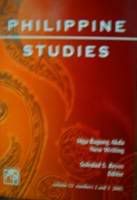
Theme: Philippine Studies for the 21st Century, New Meanings, Critiques and Trajectories
The 8th International Conference on Philippine Studies (ICOPHIL) aims to provide a forum for scholars engaged in research on the general field of Philippine Studies. Reflecting on developments and discourses that shed light on Philippine realities in a global era, this International Conference hopes to reconceptualize Philippine Studies and chart new directions for the 21st century. The Program Committee invites conference presentations from Philippine Studies Association members, affiliated societies, and local and foreign scholars in all disciplines. The Committee encourages creativity and innovation with regard to both intellectual content and presentation. In addition to panels, formats including poster sessions, thematic workshops, roundtable discussions, and other departures from traditional formal paper presentations are encouraged. The Committee particularly welcomes interdisciplinary or border-crossing proposals that complement or depart from conventional historical, chronological, geographic and disciplinary boundaries. Younger scholars are especially encouraged to participate.
Proposals should be submitted to the 8th ICOPHIL Secretariat at the Philippine Social Science Council via email (icophil@pssc.org.ph) orfax (632-924-4178 or 632-922-9621) by 15 November 2007. Proposals must include a 150-word abstract of the panel/paper as well as the name, affiliation and contact details of the proponent. Complete panels by potential chairs will be given priority but individual proposals will also be considered.
Since 1989, the ICOPHIL conference series has been held every 4 years at an international hosting institution. The 2008 ICOPHIL is hosted by the Philippine Studies Association in conjunction with the International Philippine Studies Conferences Board based at the University of Hawaii’s Center for Philippine Studies. The 2012 ICOPHIL will be hosted by Michigan State University, East Lansing, USA.
KEY DATES
| 15 November 2007 | Submission of panel/paper/ presentation ABSTRACT |
| 15 January 2008 | Notification of acceptance |
| 30 April 2008 | Submission of full papers |
| 23-26 July 2008 | Philippine Social Science Center, Quezon City |
REGISTRATION FEES
|
| Onsite | Early bird rate
(until 30 June 2008)* |
| Local Participants | PhP5,000 | PhP4,000 |
*No Refund After JULY 1, 2008
The Philippine Studies Association (PSA), convener of the 8th ICOPHIL in Manila, was established in 1984 to promote multidisciplinary research and broader understanding of Philippine society and culture. Since 1984, it has sponsored national and regional Philippine studies conferences. The PSA has also coordinated with the ICOPHIL Board, formally established in 1996, in the planning of the International Philippine Studies Conferences. The 7th ICOPHIL was hosted by Leiden University in The Netherlands.
SUGGESTED TOPICS FOR PROPOSALS/PANELS
· Theories and Dimensions of Analysis in
Philippine Studies
· Changing Philippine Institutions, Ideologies, Practices, and Technologies
· Problematizing the Nation and the State
· Globalization Issues
· Histories, Cultures, Identities
· Colonial Discourse and Post-Colonial Studies
· The Philippine Diaspora
· Gender Studies
· Human and Ecosystem well-being
· Education for the 21st Century
· Population Studies
· Philippine Media
· Similar topics may be proposed.
INQUIRIES
Bernardita R. Churchill - nitachurchill@hotmail.com
Belinda A. Aquino - lyndy@hawaii.edu
ICOPHIL Secretariat - icophil@pssc.org.ph
Tel. no. (+63)(2) 929-2671 / 456-1930
***
‘PISAY’: SUPERIOR LOCAL FILM by Mario E. Bautista
AN entry in the Cinemalaya filmfest that is destined to be a classic is “Pisay,” a contraction of Philippine Science High School. Extremely well written by Henry Grageda and brilliantly directed by Aureus Solito (who easily tops his earlier award-winning films, “Pagdadalaga ni Maximo Oliveros” and “Tuli”), the film follows the stories of several students who qualify as scholars in Pisay, from the time they enter the school in 1982 until they graduate in 1986. These are volatile times in contemporary history, so the film is not just their story but also that of the nation, chronicling the assassination of Ninoy Aquino and the EDSA People Power revolution that ousted Marcos.
The film is divided into four distinct episodes, with each episode concentrating on different students. “Freshman” is about young love. Gammy Lopez (twin brother of Nathan Lopez who played Maximo Oliveros), an intelligent teener whose mom is a market vendor, falls in love with the balikbayan mestiza, Annicka Dolonious. In the process, his grades suffer. Their concerned teacher (Eugene Domingo, who’s so great she should win a best supporting actress award for her performance here) knows he can do better and convinces him to forget about his infatuation with Annicka and to focus more on his studies.
“Sophomore” is about a fat boy from Cebu, Carl John Barrameda, who graduated valedictorian in their hometown and is now bullied by bigger boys in their dorm. He gets so terribly homesick and this affects his performance in class so badly that he lost his scholarship and was subsequently ousted from the school. “Junior” is about a girl, Shayne Fajutana, whose parents are both political activists. To complete an experiment in class, she is paired with a budding cadet, Jonathan Neri. Together, they also get engrossed in the story of Macliing Dulag and the Chico River project. They do get attracted to each other, but Shayne’s parents are being persecuted by the government so they quietly leave for abroad, with Shayne leaving the school without even telling anyone where they are going.
“Senior” is about an effeminate boy, Euripedes (EJ Jallorina), who discovers while he’s in Pisay that he’s more inclined to the arts. Pisay scholars are required to major in science courses when they go to college.
If they enrol in other courses, then they would have to pay back the government for the years they spent as a Pisay scholar. This episode opens with a play being performed on stage, with Euri playing the role of Sisa. Euri has a hard time filling up his application form for entrance exams in college because he cannot decide on whether he should take up a science course or theatre arts.
In the end, the tragedy that befalls his classmate and best friend, Elijah Castillo (the child actor who played the title role in “Pepot Artista”) helps him make a final decision.
The graduation sequence where the students are shown going up onstage to get their diplomas and citations moved us to tears. It brought back bittersweet memories of our own high school years. Uniformly well acted by a fine ensemble cast, Solito truly excels in this one as he has already mastered polishing the technical requirements of making a digital film, compared to “Maximo” and “Tuli” that are so crudely made.
The audience applauded in unison right after the screening of this film at the Cultural Center of the Philippines main theatre.
Also deserving acclaim are the cinemato-graphy of Charlie Peralta, the music of Vince de Jesus and Jobin Ballesteros, and the production design by Martin Masadao, Regie Regalado, Dante Garcia, and Endi Balbuena.
We pray a big film company will get distribution rights for this movie. Given the right push, we have no doubt this will be a big hit with the general public who will surely appreciate its merits as a superior local film.
***
Cinemalaya 2007 at the UP Film Institute
Tuesday, July 31
5 pm | PISAY by Aureus Solito
7 pm | TUKSO by Dennis Marasigan
Wednesday, August 1
5 pm | STILL LIFE by Katrina Flores
7 pm | KADIN (the Goat) by Adolfo Alix, Jr.
Thursday, August 2
5 pm | ENDO by Jade Castro
7 pm | LIGAW LIHAM by Emilio “Jay” Abello
Friday, August 3
5 pm | TRIBU by Jim Libiran
7 pm | SINUNGALING NA BUWAN by Ed Lejano
Saturday, August 4
5 pm | GULONG by Romualdo Fajardo
7 pm | BEST PICTURE WINNER REPEAT SCREENING
tickets available at the Cine Adarna Box Office @ P70 each
for inquiries, contact 09274520710